
The System
The Fundamental Structure
 AI-generated (ChatGPT)Illustration © Genesis LogicIllustration © Genesis Logic
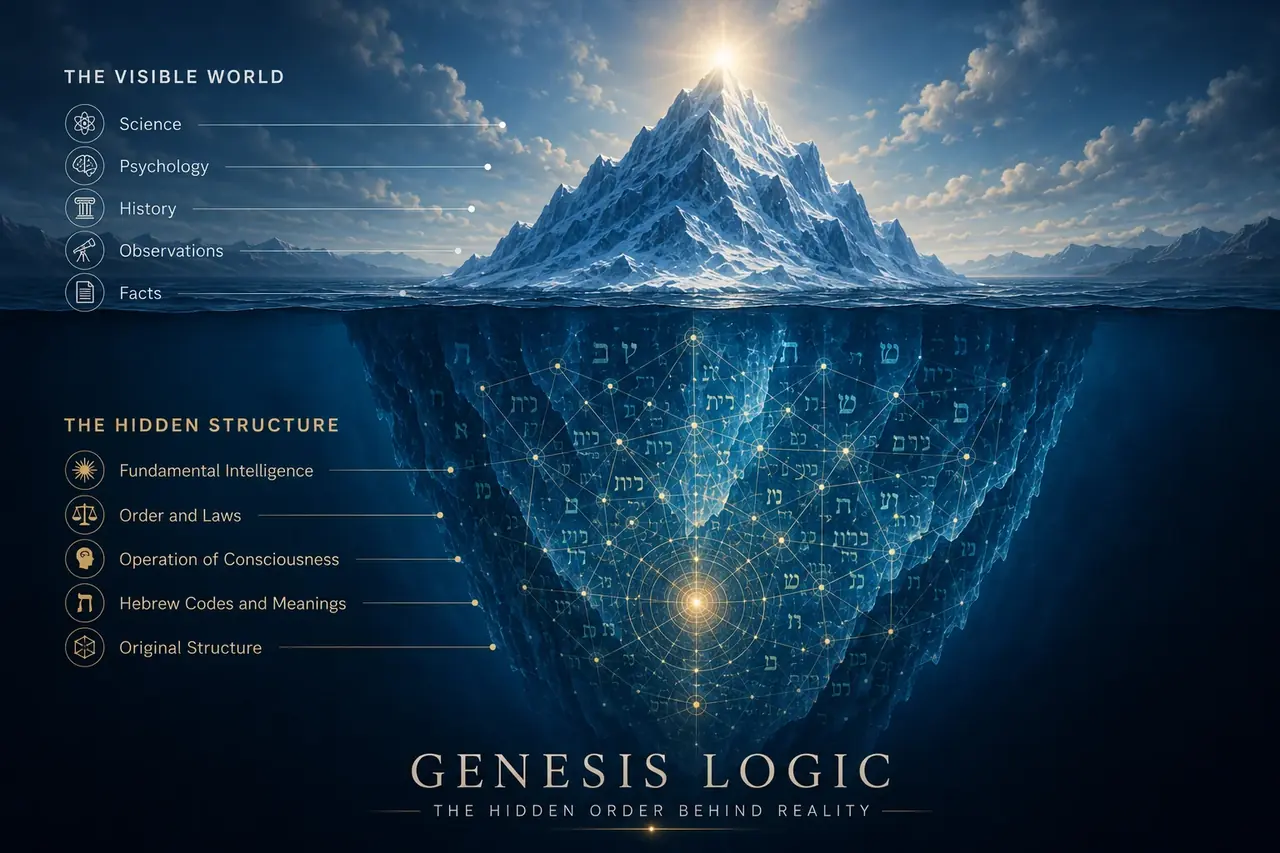
According to the Genesis Logic interpretation, at the intersection of scientific, religious, spiritual, and metaphysical interpretations of the world, only an interpretation can stand that takes all knowledge and facts into account, but does not automatically accept as true anything that has not been proven.
The foundation of an interpretation of reality begins with defining the reason for the existence of the world. Today, just as at any time in the past, we can justify this only through the manifestation of intelligence. This is not uniform among proponents of the materialist worldview, but a significant proportion of them are also able, based on the relationships and logic of the physical laws recognized so far, to conceive of the world only as a manifestation of a fundamental intelligence. In the interpretation of the system, atheism is in reality the rejection of this intelligence, which is a manifestation of opposition, a denial, rather than an independent interpretation of the world.
This is the only starting point where some degree of consensus can be reached in the jungle of theories. Assuming this fundamental intelligence, we can establish that every worldview has the appropriate foundation that leads to the recognition and understanding of reality. The differences arise from how we interpret this fundamental intelligence: as God, Tao, Dharma, simply as Higher Intelligence, etc., and then what interpretation we build upon it.
Genesis Logic attempts a synthesis of two well-known interpretations of the world, excluding dogmatic explanations from both, and creating an interpretation using only facts that can be interpreted from both directions.
The method is simple, but focused on what is essential. The basic assumption is that reality is revealed through scientific research. The natural sciences reveal the fundamental laws governing the functioning of the material world, while psychology reveals the laws governing the functioning of consciousness. If we place the knowledge available to us today within an interpretive system that is already thousands of years old, we can discover a structure that would otherwise remain completely invisible.
The basis of the interpretation is therefore the Bible. Based on the original Hebrew text, we must create an interpretation for every word that can be interpreted as precisely as possible according to our current knowledge. The words in the Bible are therefore names for definitions, and by interpreting them precisely and using them consistently throughout the entire text, they present us with an explanation for interpreting the world that cannot be achieved in any other way.
If our assumption is correct, then the Bible will reveal a structure that we have not been able to see until now because the translations of the text do not accurately reflect the Hebrew structure. The Hebrew words, names, and numbers contain meaning in themselves, but the names are naturally not translated in the translations, and thus these meanings remain hidden from the outset.
When creating definitions, we need a definition that is as concise as possible, if possible a single word or a simple sentence. In addition to this, however, an exact definition is also necessary. Therefore, in the Glossary, we record every definition and also the place where it was created. If we later change a definition for some reason, we can do so only if it also holds true in every previous passage of the text. Definitions, however, can build upon one another and can become more precise in later appearances. Therefore, if a later text makes a definition more precise, we retain both the original definition and the expanded definition, so that the development of the definition can be traced.
The first essay presents the method concretely as well, providing an example through the creation of the first definitions.