
The Role of the Spiritual Ego on the Path of Self-Knowledge
How does the seeker identity become a tool of self-knowing, and why must even this ultimately be transcended?
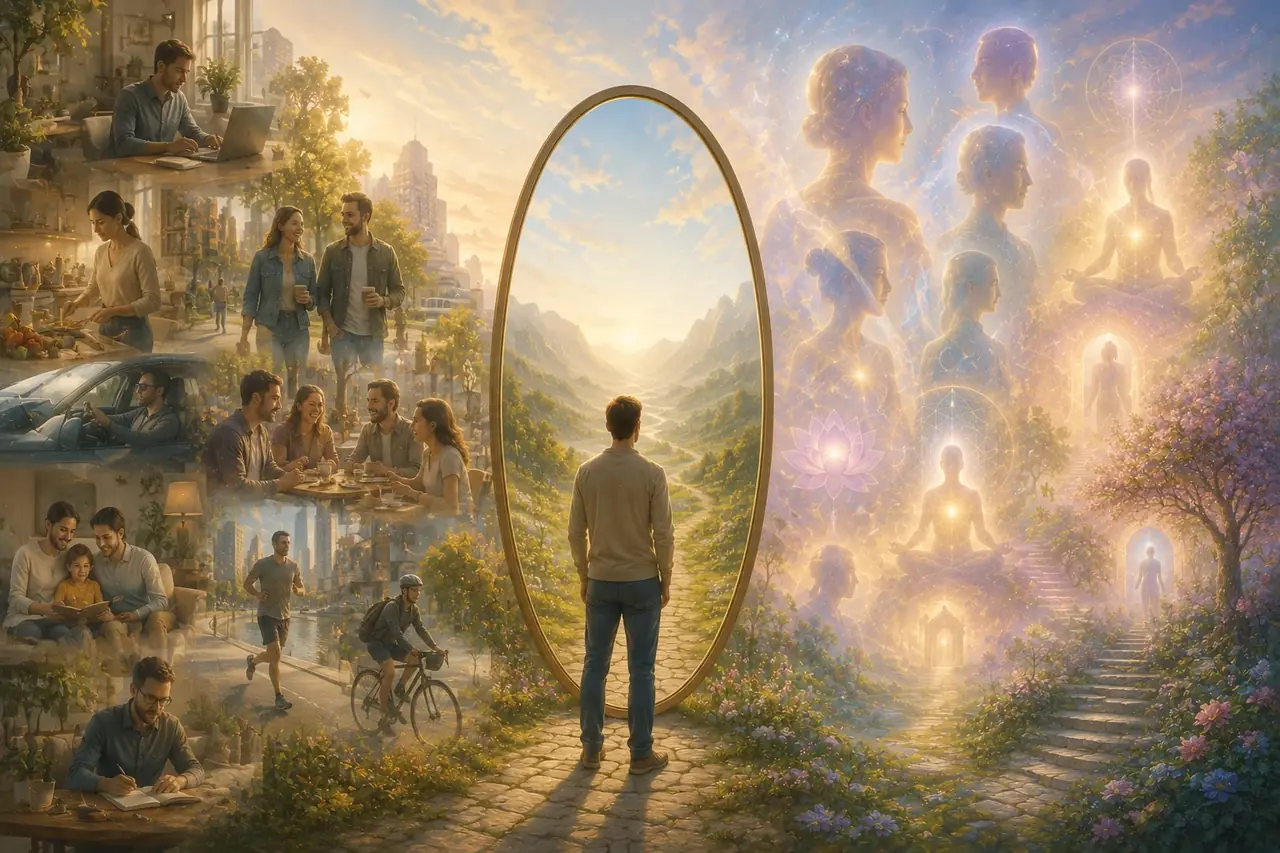 AI-generated (ChatGPT)Illustration © Genesis Logic
During development, the Human reaches a point where the appearance of his own interpretations in the world becomes recognizable — his own “effect” on the world — not only through his actions, but already through the way he interprets the world. Attention is no longer directed only outward, but consciousness begins to observe itself and begins to know the modes of its own functioning.
This is self-seeking, the beginning of the spiritual path, which changes the areas of Human interest. The spiritual ego develops, which soon comes into contrast with all the I-selves we created throughout our life.
The experimentation with various meditation techniques, the recognition of the ego, and taking a position against the ego lawfully appear in our life. The path is completely individual for everyone, but there are a few important milestones whose recognition is genuine progress. We will now place one of these under examination, which carries outstanding significance on the path leading toward the recognition of reality.
The ego is not actually an enemy, nor is it a formation that prevents us from reaching “enlightenment.” Yet at the beginning of the path, we always come to know the ego as an obstacle that must be overcome and defeated. The ego is nothing other than the totality of our definitions created from our experiences throughout our life, through which we describe the world. From these definitions, various I-states and various personalities develop, which we use throughout our life as I Am — as the best form of appearance in the given life situation, which we manifest.
Throughout our life, more and more personalities develop within us, which is not a schizophrenic condition, but an ever-expanding set of tools that makes us increasingly versatile.
At the beginning of the spiritual path, this set of tools expands with a new personality, the spiritual ego, which begins to see its own I-selves as opponents that must be overcome and eliminated in order to reach the spiritual goal, hoping to achieve the constant experience of peace and happiness.
This is a completely normal phenomenon, a step that cannot be skipped, an important part of the process of knowing. However, it is essential to recognize that the spiritual ego is also exactly the same kind of ego-I-state as all the others. Our I-states continue multiplying throughout our life, but because they consist of definitions created by consciousness, several of our I-states also use one of our definitions for the definition of themselves. Thus, our I-states become significantly interconnected, and therefore recognizable basic qualities and basic reactions appear in everyone, which manifest in a stable personality for the external world, for other Humans, and for ourselves as well.
During its development, however, the spiritual ego is an I-state created from definitions that we created during self-seeking. Therefore, these definitions do not share the formation of the self-image with other I-selves, and thus it exists rather separately within us, and stands in significant contrast with the I-selves we use in everyday life. However, our everyday life does not cease; therefore, a significant inner contrast develops between the spiritual ego and our personality built over many years — between our other I-selves. This state itself is the state of seeking, the state of becoming a seeker.
Seeking is actually directed outward. We search for books, masters, meditation techniques, retreats, new communities, and new people with similar interests, because a previously completely unknown viewpoint and direction of interest develops within us.
This state actually creates a contrast within us, where our previous personality — which means the totality of many I-states — comes into contrast with our new spiritual I, which may also consist of several I-states, yet still stands in contrast with the ego, with what we now recognize as ego within our own personality. This contrast must come into existence within us, because this makes it possible for our own inner space to become perceptible, for us to recognize our I-selves, and to recognize that our I-selves are actually groups of definitions that we use consistently in similar life situations.
The difficulty in moving forward is caused by the fact that it is easy to become trapped in the interpretation that our spiritual ego is our true I, a higher I with which we identify while moving further on the path of knowing. This is a logical conclusion that lawfully develops, but it is not reality. This is the point where it is very easy to become stuck, and one may spend years or decades on this level while continuously researching various spiritual directions, religious directions, and meditation techniques.
The genuine step forward, the next level, is actually when we recognize that the spiritual ego and our spiritual I-selves are also exactly the same kinds of I-states as all the others. We use them in different areas of our life, and they show significant contrast with our previously developed I-selves, but in reality we still use our previous I-selves for life to this day, and we still greatly need our previous I-selves as well, because in the world we continue to work, study, travel, shop, connect, and so forth.
The appearance of the spiritual ego was actually necessary so that the I-states from which our personality consists could become recognizable. Through the appearing contrast, not only our I-states but also our definitions become recognizable, from which the I-states consist.
And the recognition points out that the spiritual ego is also a group of I-states consisting of definitions, self-images formed from similar definitions, which appear through us in the world. The true result, the true recognition, is the knowing of the structure and mode of functioning of the I, which became perceptible and knowable because the spiritual ego came into contrast with the ego, and thus the contrast developed that made perception possible, that made it possible for us to see ourselves.
The recognition of the structure of the I, through which we see our own I-selves, and the recognition of the content, in which we recognize our definitions that interpret and describe reality and which form the I-selves, makes our own mental space accessible to us. While thinking, we no longer merely observe our own thoughts, but recognize ourselves within them, the building elements of our I-selves, to which we thus gain access much more consciously.
This type of consciousness gives access to consciously accessible I-content, but our emotional states do not become conscious through it; therefore, the recognition will not provide real control. It is not about becoming capable after this of “choosing” which of our I-selves should appear and what definitions it should consist of, but about our own I-selves becoming perceptible for our consciousness, and thus knowing deepens significantly in the direction of ourselves.
Our I-selves become perceptible and recognizable, and our definitions describing reality that form our I-selves also become perceptible and recognizable.
The greatest benefit of this recognition is that it dissolves the contrast between the self-images belonging to the spiritual ego and the earlier self-images. When we recognize that the spiritual ego is the totality of I-states just like the “ordinary” ego, then the contrasts begin to dissolve, because the devaluation of the ego ceases, yet the essence remains — the ability to perceive the I-states. After this recognition, we gain a much greater insight into ourselves, and during the knowing of ourselves we have taken a very significant step.
As the devaluation between the spiritual I-selves and the everyday I-states increasingly ceases, the definitions used by our spiritual I-selves and the definitions of the I-selves used during everyday life increasingly begin to use each other’s “set of tools.” The general self-image again begins to show a more unified picture, and the inner conflict begins to cease.
Our spiritual and everyday life become less and less separated, and this is the next level we reach on the path of knowing.
The interpretations we considered spiritual increasingly appear in the experiences of everyday life as well, because the I-selves used by our earlier everyday life also receive our definitions that were previously used only by the spiritual I-selves. Life itself also begins to show a more unified picture and becomes more understandable.
At the beginning, the spiritual path appears to be an individual path leading toward a new community separated from normal life, but this exists only so that a contrast may come into existence in which we recognize the functioning of our own personality and its building elements — the definitions through which we describe perceived reality, the world, on the mental level.
After we became capable of perception, this contrast only limits us further on the path of knowing. We must recognize the unreality of the contrast, but this becomes possible only if we recognize the value of the contrast. The development of the spiritual ego was necessary so that the structure and content of our own I-selves could become perceptible, and evaluation made this possible. Thus, the value of the spiritual ego and the value of the everyday ego both come into their proper place. Both receive the evaluation that belongs to them, because the everyday ego is also necessary so that we may exist in a human body, and the spiritual ego is also necessary so that we may move forward on the path of knowing.
And the recognition of the value of both egos and the ceasing of the contrast are necessary so that the contrast may cease, and so that the significantly separated definitions forming the two egos may begin to integrate into one another, because both groups contain definitions born through the knowing of reality, which in truth are not separated.
What exists appears in the world; therefore, contrasts come into existence only so that they may make something perceptible that previously we were not capable of perceiving. But once the ability of perception has come into existence, there is no further need to maintain the contrast, because perception remains even without evaluations and contrasts.
The spiritual path ultimately does not lead to a new identity, but to the ceasing of the conflict between identities. It is not a higher I that is born within us, but gradually the compulsion ceases to regard any of our I-selves as final. At the beginning of the seeking, we still want to separate the spiritual from the everyday, but the recognition ultimately joins them together again. Peace itself is not some extraordinary state, but the moment when we recognize the significance of the contrasts within us.
The spiritual path is not about freeing ourselves from the ego, but about recognizing that all our I-selves are different appearances of the same consciousness.