
Let There Be Light
And God said, “Let there be light”; and there was light.
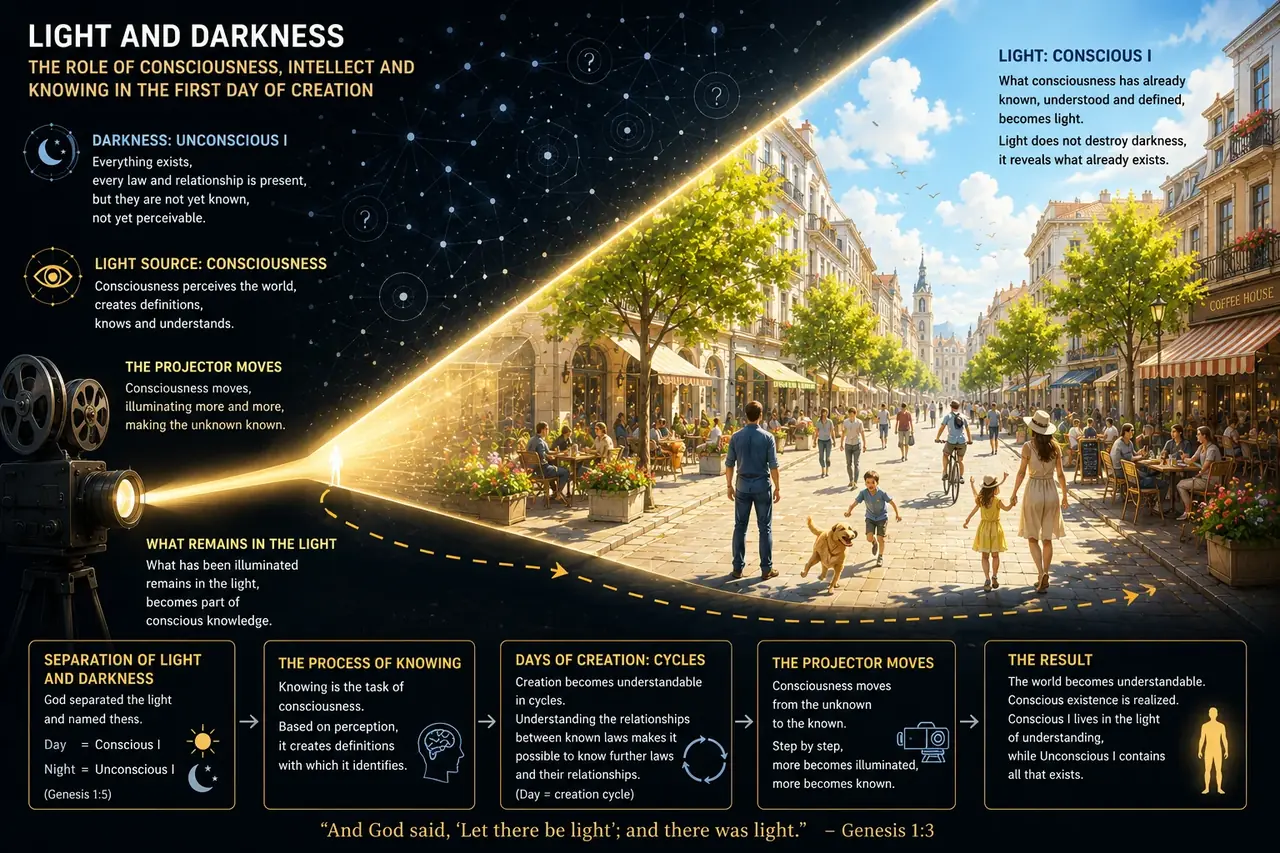 AI-generated (ChatGPT)Illustration © Genesis Logic
The word of God is nothing other than the creation of a definition, which becomes part of Heaven and defines something that appears in the material world.
Word of God: Law.
The creation and definition of laws.
Genesis 1:3
According to our previous definitions, the Earth is without form and void, and darkness is upon the face of the deep; that is, the material world exists unconsciously.
Therefore, the appearance of Light, as the opposite of Darkness, means the appearance of consciousness, because Darkness, in the above definitions, means unconscious existence.
However, it is not defined what becomes conscious. There is not yet a perceiver, nor perception. Therefore, the condition that makes conscious existence possible appears in contrast to unconscious existence, which means the definition of intellect.
This does not mean that intellect was not present before, because the deep actually means the relationships between laws that are present unconsciously, which were already present, because everything that exists can exist only in complete harmony together with everything else that exists. The laws are also the conditions of one another. Therefore, every law is connected to every other law, and they exist together and together define the appearing world.
Therefore, the appearance of Light means that the laws of God not only appear in the material world, but through observing the material appearance they can also be understood and comprehended. They form an interpretable system that can be understood by a being possessing consciousness.
The appearance of Light means the appearance of intellect, which therefore does not depend on consciousness, nor on a perceiver. Intellect exists among the laws of Heaven; therefore, it also appears in the material world through our experiences.
Light: Intellect.
The relationships present among the laws of the world, which are comprehensible to consciousness, and through the perception of the world consciousness is able to recognize these relationships. These relationships are present both in Heaven and in the material world, but their becoming conscious is what means Light. As long as no one knows them, they are still present, but they are present as Darkness, unconsciously.
Genesis 1:3
Therefore, intellect also does not depend on conscious existence. Intellect is present in the world even if the world is lifeless, unconscious, and no observer is present who could understand it.
In the following verse, God sees that the Light is good. This statement is not a qualification and not an evaluation, because the contrast of good and evil has not yet been defined. Here, at the beginning of the text, the statement, “God saw that it was good,” simply means that God has a purpose with the definition of Light, and His definition fulfills this purpose.
God separates the Light from the Darkness, which can now be interpreted concretely, because intellect is present in Darkness as well. The relationships between the laws of the world also exist unconsciously. In order for Light and Darkness not to be identical, they must be separated.
Thus, that which consciousness has already understood from the laws of the world and from the relationships between the laws becomes Light, while that which it does not yet know, that which it does not yet understand, remains in Darkness.
The Bible dedicates a separate verse to separating the interpretation of Light and Darkness from one another. Therefore, until this separation takes place, these two definitions mean the same thing.
Therefore, intellect is present in the world. Intellect is not present in the world because of consciousness. Rather, intellect is present among God's definitions, and depending on whether consciousness knows it, it becomes either Light or Darkness.
Knowing makes clear that which exists. That which exists, but whose laws and conditions of existence we do not know, exists as Darkness for us, and the task of consciousness is knowing, making conscious through experiences by means of knowing.
God not only separates Darkness from Light, but also names them.
Naming actually means a concrete definition, to which we can refer by a name after we have known it and understood it.
Naming: Concrete definition.
By recognizing, understanding, and concretely defining the laws of God, we are able to refer to a law by a name.
Genesis 1:5
God calls the Light Day, and the Darkness He calls Night. After the separation of Darkness and Light, this clearly separates unconscious existence from conscious existence.
Because God is naming the laws that define the material world here, it is important to see that conscious existence did not receive its name from the earthly daytime. Rather, the earthly days were named Day after conscious existence, because during the day there is light, and the earthly nights were named Night after the name of unconscious existence, because during the night there is darkness. This may not seem particularly important, yet it is, because these names preceded the appearance of the Human on Earth. Therefore, the names have a more fundamental significance than the things for which we use these names today.
Daytime: Conscious I.
Genesis 1:5
Night: Unconscious I.
Genesis 1:5
Conscious existence can only be realized if consciousness perceives the world, creates definitions based on its perception that describe its experiences, and consciousness is able to identify with the definitions. Consciousness also identifies with the place of perception, with the body through which it receives perceptions. However, it can identify with the body only by defining it and identifying with the definition of the body, because consciousness can identify only with what it knows, what it has come to know, what has become Light for it.
Thus, conscious existence means that with which consciousness is already able to identify, and this is the conscious I.
Thus, the unconscious I is a designation that can only be interpreted from the perspective of the conscious I, because the unconscious I means everything that exists. Every law that exists in Heaven and every relationship that exists between the laws.
Thus, the unconscious I also knows the laws and relationships that the conscious I comes to know, because they do not cease to exist merely because consciousness has come to know them. The knowledge of the conscious I is therefore always that part of existing knowledge that we know, while the unconscious I means all knowledge and all relationships that exist, and in reality the unconscious I does not possess I-consciousness. We use the word “I” only in its designation so that we may interpret it as the opposite of the conscious I, but in reality even the opposite is not real.
Just as God separated the Darkness from the Light, so the conscious I becomes separated from the unconscious I. Everything exists within the Darkness, but consciousness is able to interpret only that part of what exists which it has already become capable of perceiving, which has become Light, which has become known.
Light does not eliminate Darkness, because that which exists continues to exist even if no one is conscious of it. Therefore, Light only reveals that which previously existed for us in Darkness, unknown. Darkness actually means only that laws are present which we do not yet understand and which we are not yet able to perceive.
Because God defined the difference between unconscious existence and conscious existence, creation becomes understandable through knowing. Consciousness becomes capable of understanding everything that exists, and based on the relationships according to the laws, this appears to consciousness as a process of knowing.
This process of knowing also appears to consciousness, which is able to understand it as the cycles of creation.
Day: Creation cycle.
The Day, as a unit, based on the first chapter, represents a creation cycle.
Genesis 1:5
First Day: Consciousness, the conscious I and the unconscious I, intellect.
The first cycle of creation.
The creation of matter, and of conscious and unconscious existence. The definition of the Human’s conscious I and unconscious I.
Genesis 1:5
Creation does not actually have a chronological order. Later, time will also be defined according to its meaning and significance, but it is not yet present here.
Therefore, the system that appears here is not a definition according to chronological order, but rather creation is presented according to the perspective of understanding. The laws that define the existence of the material world build upon one another, are connected to one another, and can be understood according to these relationships.
The days of creation, as cycles of creation, are arranged according to their knowability, because they can only be understood in the given order. Understanding the relationships between the laws that have been known makes us capable of knowing further laws and of recognizing their relationships with additional laws.