
The Appearance of the Material World and the Presence of the Spirit
“And the earth was without form, and void; and darkness was upon the face of the deep. And the Spirit of God was hovering over the waters.”
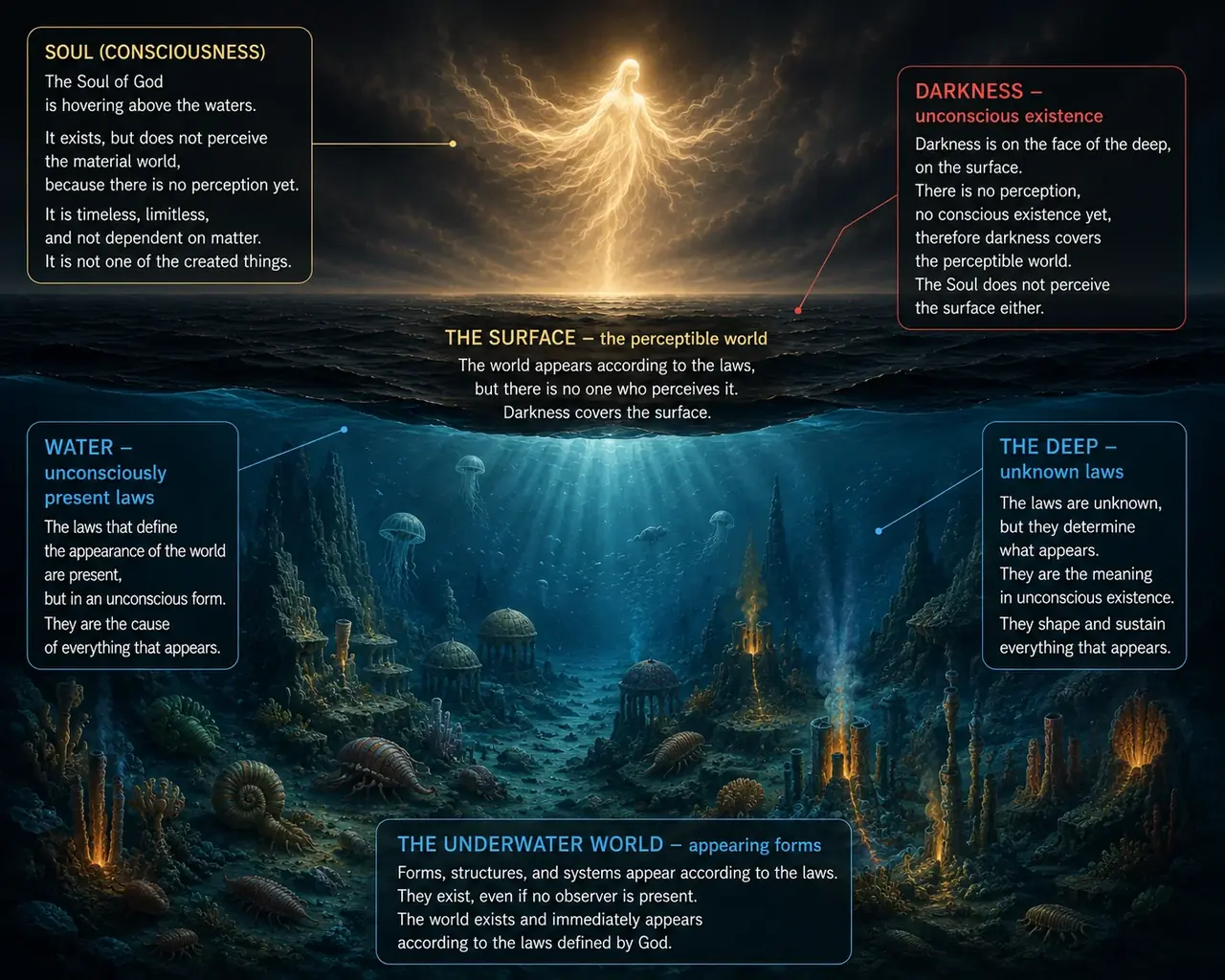 AI-generated (ChatGPT)Illustration © Genesis Logic
According to the previous definitions, the material world appears according to the laws defined by God, which are in reality the laws of physics. The appearing world is “without form and void” according to the structure presented in the Bible, which simply means that it is lifeless.
The verse also presents water, the deep, and darkness: “And the earth was without form and void; and darkness was upon the face of the deep. And the Spirit of God moved upon the face of the waters.”
The earth represents lifeless matter; therefore, the water, which has depth, in reality represents the laws of the appearance of the material world, according to which the material world appears, and whose surface is visible as the perceptible world. However, there is darkness upon the surface, because there is not yet anything or anyone capable of perceiving the appearing material world.
Therefore, the world exists according to the laws that define existence, but the laws are not visible; only the world is perceptible. However, at this point there is not even perception, and yet the Spirit of God is hovering over the waters. The location is extremely important, because the Spirit of God is not in the waters. It cannot see the laws. It is above the waters. It could see the surface if it had a body and had senses, but there is not yet a body nor any possibility of perception. Therefore, there is only darkness for the time being. No one understands and no one perceives why the appearing material world is exactly as it is.
Water: Unconscious laws.
The presence of laws in the created world, in unconscious form.
Genesis 1:2
Deep: Unknown laws.
The deep is the meaning present within unconscious existence, the presence of laws, because the existence of matter is made possible by the existence of laws, but there is no one who can interpret or comprehend these laws. There is no present consciousness. The laws that shape the world, but are not known.
Genesis 1:2
Darkness: Unconscious existence.
Existence without consciousness.
Genesis 1:2
The Spirit of God is hovering over the waters, but there is darkness — unconscious existence — therefore the Spirit of God does not perceive the material world and is not present within it. The text does not state that God creates the spirit. The Spirit of God simply appears in the description. Therefore, the Spirit of God exists just as God exists. In other words, the spirit is not one of the created things. Thus, the existence of the spirit does not depend on the existence of the world. It is timeless, limitless, and materially indefinable, just as God is.
An important point of interpretation is that the Spirit of God cannot mean that God also has a spirit through which He is a conscious being. Rather, it means that God also defines the concept of spirit, the conditions of the existence of spirit. However, the definition of spirit does not mean the definition of a material form, because spirit exists without material form. Since no material form is necessary for its existence, it already exists here and is “hovering” over the waters, but it is not yet capable of perceiving the material world.
At this point, the text simply tells us that the spirit exists, that its existence has no material conditions, but that without a material form of manifestation it is not capable of perceiving the material world.
Spirit: Consciousness
Conscious existence.
Genesis 1:2
Thanks to the second verse, we are able to interpret and define important words that occur repeatedly. Therefore, the interpretation of later texts becomes constrained within these frameworks. As we continuously define more and more words precisely, the interpretation of later texts becomes increasingly concrete. If water always means the laws of the world, which are present in an unconscious form, then this means that the appearance of the world is determined by the laws that define the world, and the extent to which we know these laws is not a determining factor.
The world exists even if no observer is present. The laws of the world exist even if no one knows them and no one understands them.
Our modern interpretations call these statements into question. However, the text of the Bible confronts us with the interpretation that the existence of the world does not require the presence of an observer. The presence of an observer is not a condition of the world's existence. Although the spirit is present and is hovering over the waters, it perceives nothing of the appearing material world. Nevertheless, the world exists, and according to the laws defined by God, whatever the laws define immediately appears.