
I Am Many
The Structural Composition of the I's
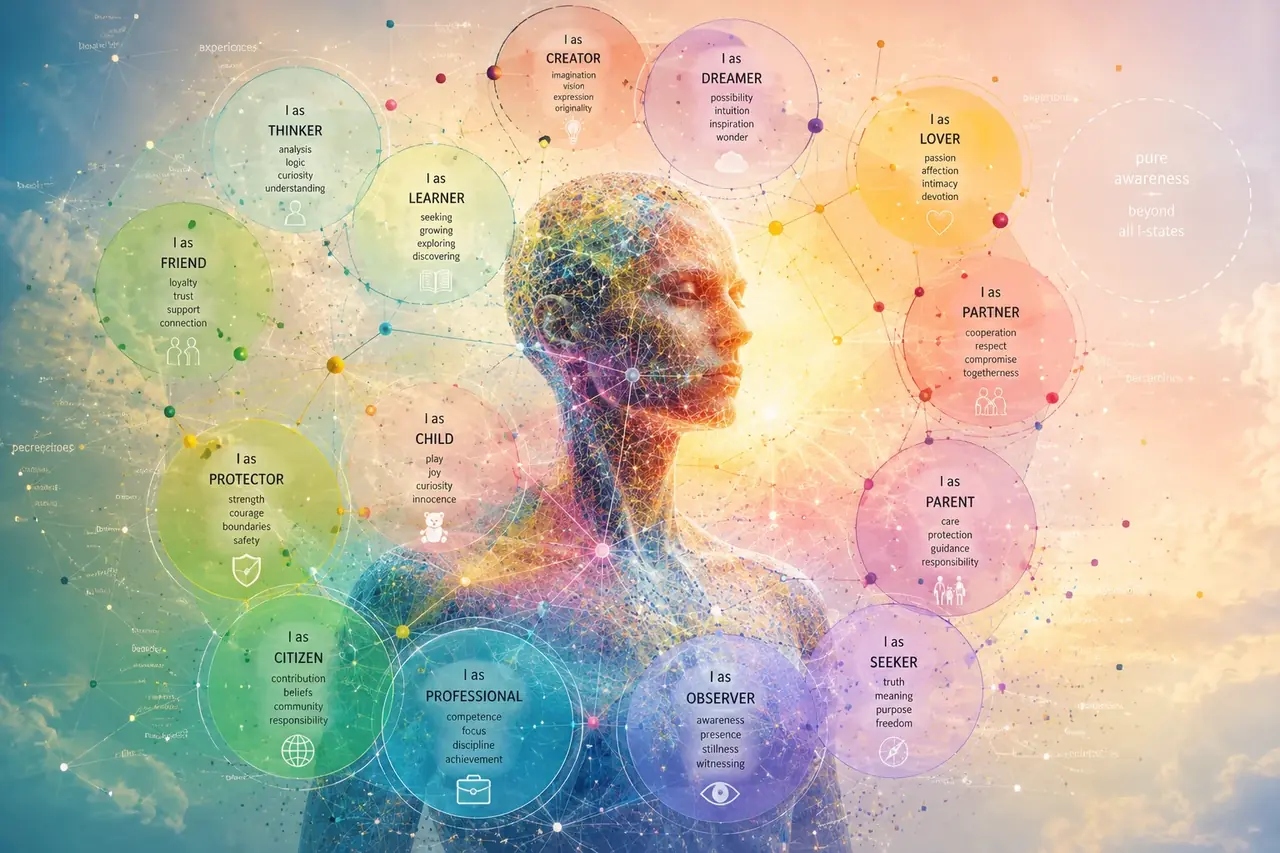 AI-generated (ChatGPT)Illustration © Genesis Logic
The experience of “I Am” is entirely unique, but because the human body is optimized and designed for perception, it only becomes possible to recognize who we truly are once a sufficiently structured network of I-states has developed within us, and the desire also arises within us to know the nature of ourselves.
This desire creates certain definitions within us that turn the focus of attention toward ourselves, and at this point the process of “becoming a seeker” begins.
As seekers, we begin to observe ourselves, and the ego becomes recognized, which is not a unified personality, but a collection of I’s and personalities optimized for different life situations.
Our seeker I also develops, who already recognizes the ego and places itself in opposition to it. Thus, the seeker I and the ego appear within us as a pair of opposites, which the seeker I recognizes and comes to know.
As we go deeper into self-observation, we discover that these I’s are actually like lenses. We do not find a resulting-I that stands above every I, but only pure consciousness behind the lens, which the I-lenses make into a personality.
We also begin to see our seeker I, but not because we enter into a different state of consciousness, but because more and more I’s also develop from our seeker I. During self-observation, the definitions that we create through observing ourselves multiply more and more, and we see ourselves in more and more different ways. This leads to the development of more and more different seeker I’s, among which some are already capable of perceiving and seeing our seeker I’s as well, because they place themselves in opposition to them in order to be capable of defining themselves.
We recognize the mechanism of I-creation, which shows that all our interpretations are connected to some kind of I, to one of our personalities. And those definitions in which we are completely certain and which are also supported by our experiences become integrated into more and more of our I’s.
Consciousness has no personality; it cannot be “I Am” unless it creates definitions from its experiences and identifies with them. Identification with our definitions makes us into I’s.
The experience of “I Am” begins where a lens is placed onto the perception of consciousness. Between the information transmitted by our senses and consciousness, a lens appears that contains definitions and says:
This is how I see the world; this is how I interpret what I perceive.
Therefore This Is What I Am!
From this point onward, we no longer simply see our experiences, but based on our already existing definitions, we decide what they are like. This is the apple from the tree: from this point onward, according to our previous definitions, we ourselves decide what is good and what is not good. Based on this, we no longer merely live our experiences, but also want to determine what should happen.
We do not want to understand the world — why things happen the way they happen, according to what kinds of laws the world functions — but instead we want to prescribe what should happen.
Consciousness by itself is not capable of interpreting the information perceived through the human body as an I, but intellect organizes the perceived information into definitions, recognizes repetitions and lawful functioning, and these definitions define our I’s. These are what we are. Everything that we have been capable of understanding from the functioning of the world. Our I’s consist of these definitions, with which we identify.
Consciousness identifies only with the definition that declares: “This Is What I Am,” and this definition connects a large number of definitions to itself, which are placed into the lens, and through these the perceived information reaches consciousness, from which intellect then creates further definitions.
The I is not a single definition, nor is it unified. That particular lens actually means many different lenses, which are themselves individually complex, and which we continuously exchange according to the experiences we are currently living through. We define ourselves completely differently in different life situations. We do not simply behave differently toward different people or in different life situations, but entirely different I’s appear. We exchange the “lens” according to our needs.
We can best imagine our I’s if we imagine a large set that contains all our definitions. From these definitions, one portion of definitions forms one I, which we could represent with a circle containing definitions. These I-circles can overlap each other; within one larger circle, a smaller circle — or even several — may exist entirely. But we can also have completely isolated I’s that do not share a single definition with any of our other I’s, just like our seeker I when we begin to ask the question: “Who am I?”
We have defined I’s for every life situation that regularly appears in our lives. We have a defined I for when we speak with our boss, another for when we speak with our colleague, but we may even have a completely different defined I in relation to another colleague; another at home toward our wife, and another toward our child; another in the store toward the salesperson, or at the gas station, and at the newsstand… The list could continue endlessly, because we have an I for every recurring life situation, a “lens” according to which we appear.
In new, non-recurring life situations, we use whichever of our existing I’s seems the most appropriate at that moment, but if none of them seems appropriate, then without difficulty we create one from the definitions available to us. In a single moment, we create another new circle that contains the definitions that seem the most appropriate. If the situation resembles one for which we already have a well-functioning I, then we use that one, but if the situation changes, then without difficulty we switch to another I-state, to another “lens.” All of this happens unconsciously until we recognize all of this.
The situation is even a little more complex than this, because for the same life situation, toward the same person, several of our I’s may also appear. For example, we behave differently toward our boss when we agree with him than when we see things differently. In such cases, we do not simply behave differently, but another one of our I’s also appears. For example, we may have an I that “handles everything,” an I that “knows everything better,” an I that says “I have no idea,” or an I that says “I cannot do this,” and in fact many other possibilities also exist, but generally we use a few very frequent I-states — always the one that we find the most appropriate.
Without understanding our I’s, we always defend our I’s — always whichever one through which we are observing the world — and if the appearing reality contradicts what we represent, then we defend it as if it were our own life. Many times this defense manifests in such a way that we quickly replace the “lens” with an I that is very capable of defending itself and confronting others.
By recognizing the functioning of the I, we can easily recognize that in reality we have I’s — many different I-lenses through which we observe and interpret the world. We always use the most appropriate lens in order to be able to give the best possible response to the appearing experiences. All of this functions unconsciously, but as soon as we recognize it, it begins to become conscious.
Recognition itself, understanding itself, has an effect. No effort is required for it; the recognition of the I’s will not be the result of a meditation practice, but is produced by understanding. At first, we are only capable of recognizing and defining afterward which I appeared a few minutes ago, or even earlier, but because we recognize ourselves, this conscious presence gradually moves closer and closer to the present.
The more deeply we know ourselves, the more deeply we recognize our I’s, the more capable we become of recognizing that we do not perceive the appearing experience purely, but instead evaluate and interpret what we experience through one of our I’s. Evaluation and interpretation change the experience — this is what our I does with the experience. In this way, the appearance of reality becomes evaluated, becomes good or bad. When we also see our I — because within the experience we already recognize that right now we are evaluating this as good-bad-whatever because we are like this-or-that-or-something else — then we recognize the process of evaluation within the experience, and our appearing I also “appears” before us.
The recognition of the I is a very deceptive experience, because when the need appears within us to recognize our I’s, that itself is also an I-state. An I comes into existence that wants to know the other I’s as well, with which consciousness identifies during our life. Our life, our experiences, are bound to the body, and the senses of our body determine our experiences spatially, therefore the created definition comes into existence among our I’s, but it becomes an I that is capable of seeing and knowing the other already existing I-states. A lens comes into existence that recognizes the existence of the other lenses and is also capable of knowing them.
It is important to recognize this so that we do not overevaluate the appearing I that seeks to know itself through knowing the other I’s, and do not identify it as some kind of “higher I,” because this I is exactly the same kind of I as all the others. A lens through which we perceive our experiences in such a way that we are also capable of recognizing and knowing our I’s during the process.
Knowing this I will not require yet another higher I, because if we recognize it, then in itself — that is, while identifying with it — we are also capable of “seeing.” Seeing, that is, understanding and interpreting that it is through this I that the information we experience reaches consciousness, but if one of our I’s is also present within the experience, then according to the interpretation of that I, the experience we perceive also receives evaluation.
In practice, our I’s appear in the third person within our experiences, but this identification actually fluctuates. Consciousness, identification, jumps between the first person and the third person, because identification is necessary for the living of I-states. “I Am” is complete identification, and “there is my I that appears” is the perception of our I from another I-state. However, complete identification is necessary for the appearance of the I, because without the experience of “I Am,” existence as a Human is not possible.
The process is practically a repeating cycle. We define the I with which we identify, and then through this I we create newer and newer definitions, which appear as newer and newer I’s in our lives. While identifying with these I’s, we live our lives, and these create even more definitions. During identification with the I’s, contradictions appear between our I’s.
The recognition of this whole process points to the essence:
Our I’s actually consist of definitions.
These definitions assemble into I’s so that in a given life situation we can give the most optimal reactions, so that we do not have to continuously look at the world through all our definitions, but in reality all our definitions about the world are us.
The reduction of mental burden is that we look at the world through a set of definitions compressed into a particular I, as “right now this is what I am.”
Our I’s are practically separated so that our contradictory definitions can continue to exist and do not destroy one another. Our separated I’s keep our contradictory definitions separated from one another, and in this way all of them are capable of existing within us.
These definitions contradict one another, but because we defend each side through one of our I’s, the tension appears between our I’s as inner tension.
This recognition is of decisive importance: to recognize that in reality all our I’s are collections of definitions, therefore in the final analysis we are our definitions, which we formed from our experiences.
Our further experiences then test our definitions to determine how accurately they correspond to reality, but because our definitions became arranged into smaller groups according to I-states, these groups became independent entities and they have will — they want to change the world and experiences.
The recognition of this already counts as a significant turning point on the path of self-knowledge, because it points out concretely that our experiences actually serve the purpose that our definitions describing the world become increasingly accurate. During experiences, we begin to observe our definitions, and we change ourselves by aligning our definitions more and more precisely with reality.
At this point, the knowing of the world and the knowing of ourselves become connected irrevocably, and we understand that the two are actually one and the same thing.
This is where true self-knowledge begins: we begin to work on making our definitions about the world increasingly accurate.
Our I’s grow larger and larger, because our field of vision continuously widens, and more and more definitions are present in almost every I-state. This is practically the expansion of the perception of consciousness, which previously continuously narrowed because our I’s became increasingly separated from one another, and thus a particular lens allowed less and less information to pass before consciousness and intellect, but with more and more evaluation and intention to change.
During the process of knowing, this reverses, and we have more and more definitions about the world that contain no evaluation whatsoever. Thus, no desire or will appears through them, and intellect becomes capable of describing with even greater precision the experiences appearing in reality from the perceived information.
Consciousness does not actually become larger — it has always been limitless. Our lenses become increasingly clearer. We need our I’s because we are Humans and we live among Humans. We connect, exist, and communicate. But the I’s perform less and less evaluation and become broader and broader in their field of vision, and thus we change fundamentally.
The change, however, actually takes place in very small steps.
Every one of our I’s is a collection of definitions, and we change our definitions, which our I’s use for defining themselves, incorporating them into the lenses, into themselves.
The essential thing is not the recognition of the lenses, nor is it necessary to define them separately one by one, but rather their building elements. The building blocks are the definitions, which we see more and more clearly day by day, and thus the transformation of ourselves — through the conscious creation of our definitions, through aligning them with the appearing reality — becomes an increasingly conscious process in which less and less will appears. Will continuously transforms into the intention directed toward understanding the world, which is nothing other than intellect.
Beyond the lenses, intellect creates definitions, which consciousness sees and through which it observes the world.
If there is no longer any evaluation, then there is no lens either, there is no evaluation of any kind that colors the experience, and thus only purely perceived information reaches consciousness. Intellect then creates its definitions from it.
Thus, the only entity with which consciousness can identify remains intellect.
And the visibility of the definitions is no longer limited by anything, because there is not a single lens that would dampen any perception.
Self-knowledge is actually equal to the knowing of the world, for which the human body is available to us, making the perception of the world possible, and intellect, which is capable of recognizing every law that defines the world from perceived experiences.
Identification with our I’s limits intellect in knowing the world, therefore it is necessary to recognize our I’s. After recognizing our I’s, we then recognize the building elements of our I’s — our definitions — and through them we recognize our evaluations, the knowledge of good and evil, which limits and narrows the I’s.
This recognition opens the gate toward knowing.
We begin to know ourselves, we begin to know the world as it truly is.