
In the Image of God
How can the Bible be interpreted if we use our knowledge for interpretation rather than the dogmas of religions?
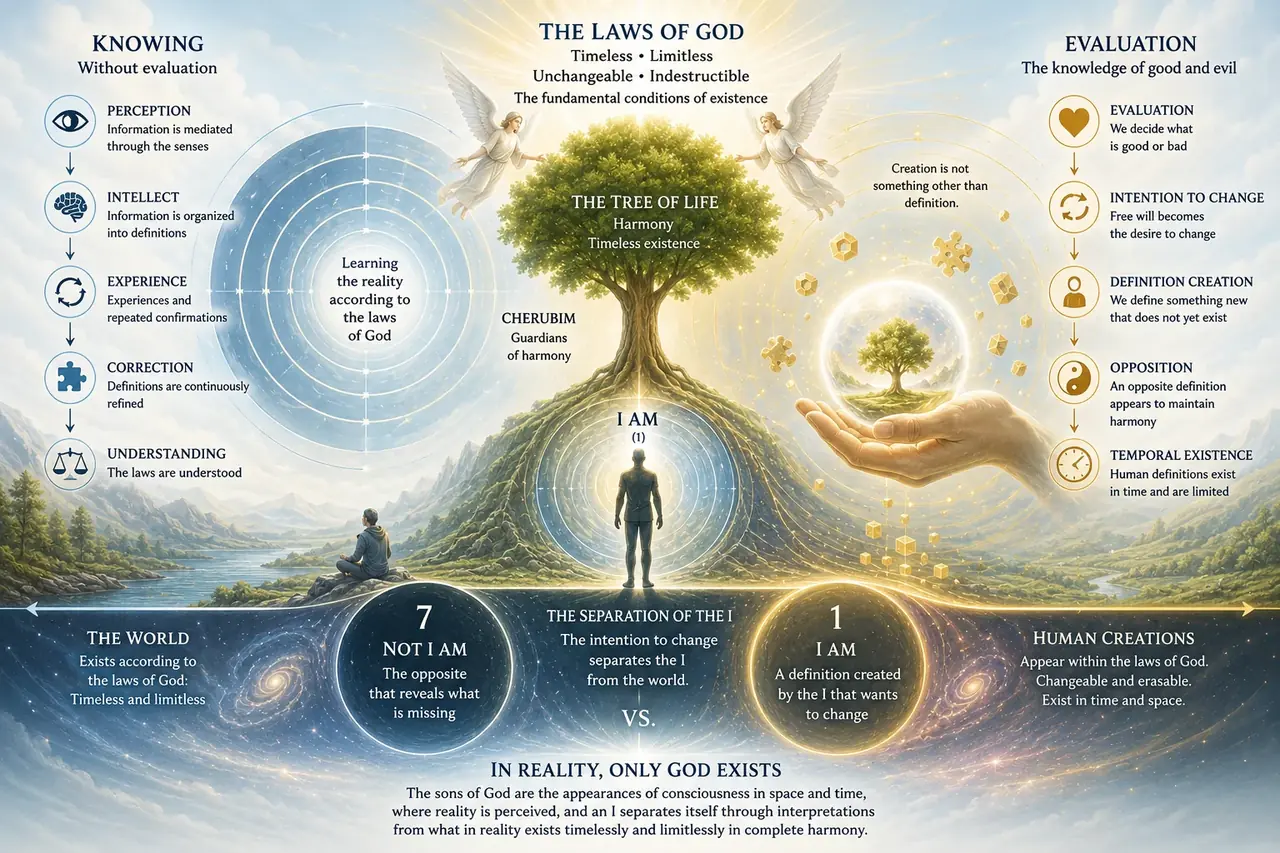 AI-generated (ChatGPT)Illustration © Genesis Logic
Every definition of the Human consists of information that originates from the perception of the material world. The human body mediates information through the senses, which intellect organizes into forms: into definitions.
(“Human” is intentionally capitalized throughout the text to distinguish the conscious being from the biological human body.)
However, information is not only perceived through experiences, but also evaluated. This is the knowledge of good and evil, which we first acquired — the first definition that can be interpreted as the result of a process, as fruit. Evaluation creates a kind of “perception” that is not mediated by a sense organ, but instead assigns a “value” to every perception, which is the place of the perception on the axis of good and bad.
We decide about everything what the things we experience are like. However, through this evaluation we not only experience the appearing world, but also want to change it. Since evaluation appears, the intention to change also appears. Free will is what is being spoken about here, but free will was not created by evaluation — evaluation only caused free will to become an intention to change.
Free will is present in the Human even without evaluation, but because there is no evaluation, there is also no intention to change. Thus, through experiences, free will wants to know why what is experienced happens. Without evaluation, free will wants to understand why what is experienced happens precisely in the way it appears within experiences. It wants to understand according to what laws the material world appears, and according to what laws what is experienced takes place.
The desire for understanding appears in such a way that, with the help of intellect, consciousness continuously organizes the information mediated by the senses into meaningful definitions, and recurring experiences continuously provide confirmation about whether the created definitions correspond to experienced reality. If experiences do not correspond to the definitions created by intellect, then consciousness continuously reshapes its definitions by using the new information until they fully correspond to what is experienced.
This is a perfect process that makes us know what appears in the material world and makes us know the laws of God, but no ability appears beyond knowing. However, God created the Human in His own image and likeness not only so that the Human would be capable of knowing the laws defined by God, but also so that the Human would be capable of creating laws: of creating definitions.
During the process of knowing, we already create definitions from perceived information, and through recurring experiences we become capable of continuously modifying our definitions until they correctly describe experiences under all circumstances, but this is still not the creation of a new definition — it is only the ability to create definitions.
A new definition can only come into existence if a need arises for something that God has not yet created. This is what the knowledge of good and evil makes possible, which the Human received from God, and through which the Human becomes capable of defining something that is not yet present, that does not yet exist.
The world exists according to the laws of God, but the definitions of the Human appear in the material world just as the definitions of God do, according to which existence itself takes place. The difference between the definitions created by God and those created by the Human is that the definitions of God fundamentally define the world.
The laws of God possess the following qualities: they are timeless and limitless, unchangeable and indestructible. They are the fundamental conditions of existence. However, the definitions of the Human are not timeless, not limitless, changeable, and can also be erased. The laws of God define the world, while the laws of the Human shape it, but only within the laws of God. Since the laws of God are timeless and limitless, the laws of the Human are incapable of changing anything that already exists, and the world exists according to the laws of God timelessly and limitlessly.
The laws of God are timeless and limitless because they exist in complete harmony; there is no contradiction whatsoever among the laws of God. The Human is just as capable of creating, of creating laws that define worlds, as God, but because the laws of God are timeless and limitless, the laws created by the Human are only capable of appearing in a limited way within time and space. The definitions of the Human can contradict one another and can also contradict the laws of God, but they are only capable of appearing within the laws of God, because those laws are timeless and limitless.
If the definitions created by the Human do not correspond to reality, then an opposite definition also comes into existence, which balances the contradiction, and it also appears in the world together with the definition created by the Human. However, the Human does not know it; it will appear within experiences so that the Human may recognize what is still missing from the created definition — what could not yet be formulated based on previous experiences.
Based on this, even without evaluation we create definitions that do not correspond to the laws of God, because we must create them based on our experiences. However, it is not possible to experience and understand the laws of God in a single moment; therefore, we are only capable of receiving and processing information by moving through time. Yet through correct interpretation, we continuously come to know the laws of God more and more deeply. No intention to change can appear — we only recognize the appearing opposites in the world, and thus create increasingly precise definitions from our experiences.
Evaluation makes us capable of “wanting” something other than what already exists. Evaluation makes us capable of wanting to change what we experience instead of only wanting to understand it. The problem arises because the realization of the intention to change is also only possible through the use of intellect, and thus we do not use intellect to know the world, but to change it. In addition, the intention to change also creates separation. Until this point, the world simply existed, but when the intention to change appears, the one who wants to carry out the change also appears.
Thus, existence becomes separated existence; thus, the Am becomes I Am.
It follows from this that the I Am is also one of the definitions created by the Human. The I Am is just as much one of our definitions appearing in time as every other definition, and opposite it appears that which reveals what is still missing from the definition so that it may exist in harmony with everything else that already exists.
If we are capable of wanting anything that does not yet exist, then we must define it, but the definition will appear within the world that exists through God, therefore its opposite will also appear, balancing it so that the world and everything within it may exist in harmony. If what we want to define is not possible, if it is incapable of existing in harmony within the world through any opposite definition whatsoever, then that definition does not appear either — not in the form in which we defined it. What appears in the world is possible, but it is possible that it is only possible within time, because it appears only in opposition to something else, just as everything in the life of the Human does, since the Human, as a separated I, also exists only within time in the world.
However, through knowing, if we do not define further changes, then through the appearing experiences we become capable of aligning our own definition ever more precisely to appearing reality, and thus we may also define something that is capable of existing in complete harmony with the laws of God. If we reach this, if our definition is present within all our experiences in such a way that no opposition is present anymore, then the Cherubim appear in our lives, then we also come to know the Tree of Life, and what we define becomes timeless and limitless.
This is also how we come to know the laws of God: we define them based on our experiences, thus we may rightfully assume that whatever we create in the world, God has in reality already created it. Only within the process of knowing does everything appear as our own creation to us, because within the process of knowing the I comes into existence, which creates interpretations according to which the appearing I acts and changes.
The I Am, the number 1, clearly appears in opposition to the number 7, which is the Not I Am, the appearing opposite, and together the two reveal what it is that truly exists.
The will that appears through the I is also the will of God, but the I identifies with it. As a separated formulation, the I Am exists in the world together with its opposite. Identification with the I interprets the appearing events as the realization of the will of the I, because the I wants to change. The world happens, but the I identifies to such an extent with what it perceives that it interprets what happens as itself and as its own will.
God alone truly exists, and through the Human, God appears as I Am in countless forms, and comes to know the world that He created in every possible form down to the smallest detail.
The sons of God are the appearance of consciousness somewhere within space and time, where the perception of appearing reality takes place, and an I separates itself from the world based on interpretations — from the world that in reality exists timelessly and limitlessly in complete harmony.