
Six Days and One More
How the Six Creation Cycles Become the Reality We Experience
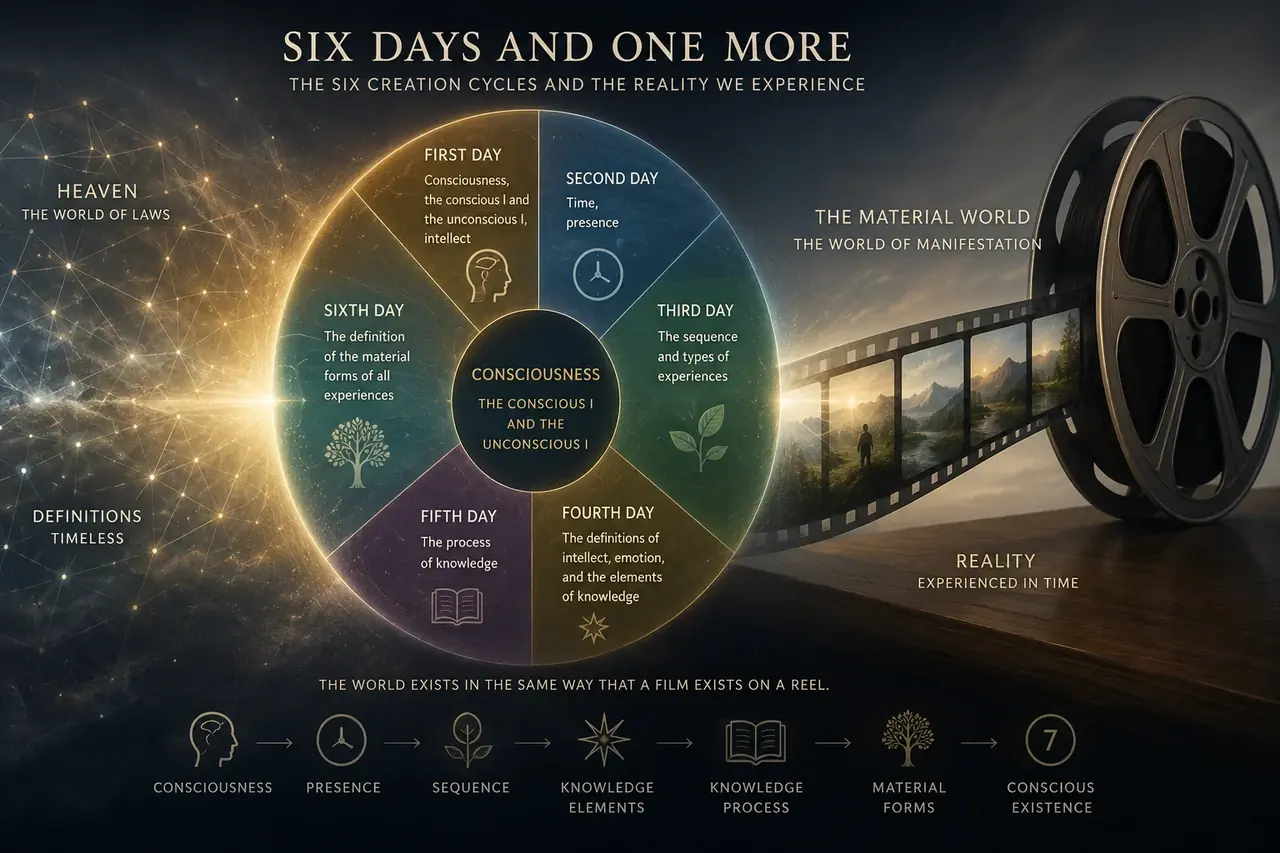 Illustration © Genesis Logic
The existence of the world, understood through the knowledge available to us today, yet interpreted within the framework of the Bible, presents a worldview that follows from no religious interpretation. It does not require faith from us; rather, it invites us to think, and it fundamentally challenges the generally accepted worldviews of our time.
Within the Genesis Logic framework, the six days represent six creation cycles. These cycles build upon one another and define everything that exists in the material world. Furthermore, they also define why, for the Human, the existence of the world unfolds in time, and why that which, in reality, exists on the basis of the six creation cycles—exists timelessly and is completed entirely at the end of the sixth day — appears instead as a continuously changing and unfolding process.
"And on the seventh day God ended His work which He had made; and He rested on the seventh day from all His work which He had made."
What follows is a brief, outline-style presentation of the interpretation of the six days based on the foundations of Genesis Logic. It provides a highly condensed summary of the fundamental principles of the system.
First Day: Consciousness, the conscious I and the unconscious I, intellect.
First Day: Consciousness, the conscious I and the unconscious I, intellect.
The first cycle of creation.
The creation of matter, and of conscious and unconscious existence. The definition of the Human's conscious I and unconscious I.
Genesis 1:5
According to the description in the Bible, the material world is like a projector. What has been defined in heaven—that is, in the world of laws — appears in the material world.
Definitions build upon one another; therefore, every subsequent definition comes into existence among the definitions that have already been created. It follows from this that the order of definitions is of fundamental importance, because a definition can only be limited by definitions that already exist.
Therefore, the definitions that already exist always provide the framework for subsequent definitions. Likewise, every limitation that has already appeared in the definitions also appears in the material world.
The First Day represents the most fundamental definitions, which define the foundations of the world. These definitions present a completely different picture of the world from the one we currently perceive, because the material world is not fundamental — quite the contrary. The material world is only the projection of the world of definitions, where the primary reality is not material forms of appearance, but the way definitions build upon one another.
Consciousness is the most fundamental definition according to the description of the First Day, and it has no material manifestation. Consciousness has no opposite. The Spirit of God was hovering over the waters, yet there is no mention of the creation, definition, or any limitation of the Spirit of God, nor of any material form of manifestation. The Spirit of God is consciousness — a fundamental essence for which even the Bible provides no explanation. At first, this may seem strange; however, because everything else is defined, this also has an interpretable significance.
The definitions that appear in the material world exist in interaction with one another and in relationships of dependence. Therefore, the fact that consciousness has no definition means that the existence of consciousness depends neither on the existence of the laws nor on material forms of manifestation.
The definition of the conscious I and the unconscious I is established according to how much of the definitions in heaven is known by consciousness. What consciousness knows becomes part of the conscious I, while everything else remains part of the unconscious I. It follows from this that the unconscious I contains everything that exists, whereas the conscious I is the part of the unconscious I that consciousness has already come to know.
The process of knowing does not only mean coming to know the definitions themselves, but also coming to know the relationships of dependence and limitation between the definitions. Every one of our definitions has many material forms of manifestation, depending on the circumstances under which, and the interpretations and evaluations through which, we experience the manifestation of that particular definition.
Intellect is neither a quality nor an IQ score. Intellect is the relationships between definitions. Every definition that already exists limits and provides the framework for newly created definitions. These limitations also appear in their material forms of manifestation, in the material world. A law defined earlier limits a law defined later; however, this "earlier" and "later" do not refer to chronological order, because time itself also appears as a result of definitions. The order in which definitions are created determines which definition is of a higher level and therefore has limiting power over the definitions created later.
Intellect is the recognition of these relationships. Definitions appear in the material world, and their forms of manifestation reveal the framework within which each definition is able to exist. The recognition of these frameworks is intellect, which consciousness only recognizes.
Therefore, intellect is also a fundamental definition. It is not a property of consciousness, but the recognition of the network of relationships between definitions.
Thus, the First Day is the description of the four fundamental definitions, which do not yet determine the manifestation of anything, but they determine the order and logical structure of the relationships between definitions, as well as the manner in which they become knowable, through which the definitions become conscious.
Definitions are like individual lines of code in a computer program. We may understand them and learn what each line of code does, but we only see the actual mode of operation when we run the program. The lines of code written in heaven run in the material world, and the relationships, the effects, and the material forms of manifestation appear.
The material world is perceptible, and here we can recognize not only the code — the lines of code — but also every relationship that exists among the laws of heaven. These relationships are the manifestation of intellect, which is far more than merely knowing the laws.
The definitions of the First Day are the most fundamental laws, to which every other law adapts, because they are the foundation. In contrast to the materialistic worldview, according to the description of the Bible, the material world is the form of manifestation of the laws, and it is in the material world that the chain of relationships between the laws becomes perceptible. Consciousness, through the perception of material forms of manifestation, is able to recognize the laws and understand the network of relationships between them.
Second Day: Time, presence.
Second Day: Time, presence.
The second cycle of creation.
The present moment as the source of knowledge. Presence, the definition of the process of the present moment. Heaven, the gate of the knowledge of laws, is the present. Time: the definition of past, present, and future.
Genesis 1:8
The second cycle of creation is the creation of the conditions of time. This is logical and understandable, but it is also significant, because every cycle of creation is built upon the definitions that already exist and appears in accordance with them.
During the first cycle, it was defined that definitions appear in the material world, where their relationships to one another also become manifest. In the material world, God's laws appear in a form that can be experienced.
During the first cycle, conscious and unconscious existence were also defined, and they alternate with one another. Thus, through repetition, the laws that appear in the material world become recognizable.
The definition of time has significance and meaning only from the perspective of the conscious I, because for the unconscious I, the world simply exists. The conscious I is that whose knowledge continuously changes. Consciousness requires time and a sequence of experiences for the process of knowing, so that what it has already come to know may appear in the material world, and, based on its experiences, it may connect additional laws to those it already knows.
The knowledge we possess determines what we are capable of perceiving, because we can only connect what we experience as something new to our current knowledge.
Based on our knowledge, our perception is also determined, because even if we have a sensory organ capable of perceiving something, we cannot understand it without sufficient knowledge. For example, there is no point in turning the pages of a book if we cannot read. We may see every letter and every word, yet we cannot understand the content.
The later narratives provide great assistance in understanding time, because God knows exactly what will happen at every moment and in every place, what we will feel, what we will will, and what we are capable of.
The laws determine what will happen. Our current knowledge determines only our will, because it depends on how much knowledge we currently possess and what kind of knowledge we possess.
Within the already existing world, according to the laws of the second cycle of creation, a timeline comes into existence. By progressing along it, consciousness is able to come to know God's laws through the experience of the material world.
Third Day: The sequence and types of experiences.
Third Day: The sequence and types of experiences.
The third cycle of creation.
The continuous, recurring appearance of laws in matter. The appearance of the living in matter. It continuously provides the possibility for experience, for knowledge, and for understanding.
Genesis 1:13
The first cycle defines the relationship between Heaven and Earth. The definitions of Heaven appear in Earth, in the material world. A definition is a definition because it defines something that appears in the material world.
Consciousness is not among the definitions. However, it is defined that the world exists unconsciously, and that consciousness is present above the unconsciously existing material world: “And the Spirit of God was hovering over the waters.” Through the perception of the material world, consciousness comes to know the unconsciously existing world, and thus that which exists in Heaven becomes conscious.
According to the second cycle, experiences reveal the laws of Heaven separated in time and space so that they may be comprehensible and distinguishable from one another.
The third cycle is the sequence of experiences, which is ordered according to the knowledge that consciousness currently possesses, because the laws that have already become known determine which laws we are capable of knowing. The knowledge already available to us determines what we are currently capable of knowing, because we are capable of perceiving only what can be connected in some way to the knowledge already available to us.
Based on the network of relationships that exists among the laws, new knowledge can be connected to the knowledge already available to us, and this is the knowledge that we are currently capable of knowing. Therefore, the sequence of experiences also appears for us in a defined order, so that we always participate in experiences in which the laws that have become knowable and accessible appear in such a way that we are capable of perceiving and interpreting them.
Fourth Day: The definitions of intellect, emotion, and the elements of knowledge.
Fourth Day: The Definitions of Intellect, Emotion, and the Elements of Knowledge.
The fourth cycle of creation.
The definition of intellect and emotion, which, through experiences, lead to knowledge, to the knowing and understanding of concrete laws (stars).
Genesis 1:19
In the first cycle, the laws of Heaven appear on Earth. A law is a law because it defines the existence of something that appears in the material world. Consciousness is present, and the conscious I emerges from unconscious existence by beginning to perceive what appears in the material world.
The second cycle defines time so that consciousness perceives the material world in a way that is limited by time and space, enabling it to distinguish the laws of Heaven. Thus, it becomes capable of perceiving and comprehending separately that which appears in the material world.
The third cycle is the sequence of experiences, which arranges experiences according to the knowability of the laws and always presents the appropriate experience to consciousness. The laws that are already known determine what we are currently capable of knowing, because, based on the network of relationships among the laws, we are able to know only what can be connected to our current knowledge. Therefore, the sequence of experiences arranges the laws to be known in the appropriate order.
The fourth cycle consists of the forms of the laws of Heaven formulated by intellect: concrete definitions that shine like stars for consciousness. Intellect creates definitions from experiences, through which it becomes capable of perceiving the appearing experiences with even greater clarity.
In this way, the conscious I emerges from unconscious existence by existing in the material world identified with the definitions it has created, and its already acquired knowledge is present in the world as the I.
The light of consciousness is the knowledge that it possesses, and through experiences, new knowledge continually becomes accessible and knowable.
Thus, the fourth cycle defines knowable knowledge as individual elements, as definitions, as units that can be defined by intellect.
Of knowable knowledge, the knowledge that is already known becomes part of the conscious I, while the knowledge that is not yet known exists unconsciously. During experiences, knowledge that cannot yet be perceived or known influences consciousness as emotions, because consciousness does not yet possess knowledge to which it can connect what appears during its experiences.
Thus, the unconscious I always contains all laws. One part of the laws is already known, and this becomes the conscious I. One part has already become perceptible, and this becomes knowable knowledge, which appears in experiences. One part is not yet knowable, but already appears in experiences at the level of emotions. The remaining laws cannot yet be perceived even at the level of emotions and therefore remain completely inaccessible to consciousness. They become perceptible only as knowledge continues to develop.
Fifth Day: The process of knowledge.
Fifth Day: The process of knowledge.
The definition of laws as the appearance of emotions, then in known, conscious form and as information, through which we come to know them, become certain of them, and they become part of our conscious I.
Genesis 1:23
The process of knowing takes place according to the way knowledge is built upon itself, based on the network of relationships among the laws. Those laws that we cannot yet connect in any way to our existing knowledge are not perceptible to us during our experiences.
The process is as follows:
The laws that have already become known constitute the conscious I. Consciousness identifies with what it has come to know; the information assembled into definitions by intellect constitutes the conscious I.
The laws that have already become known make it possible to know additional laws that are connected in some way to the laws already known. These appear in our experiences, which were determined in the third cycle of creation so that we experience precisely those experiences that reveal the laws that are knowable at that particular stage.
During our experiences, laws also appear that we cannot yet connect to our knowledge, because our existing knowledge is not yet capable of revealing the network of relationships through which we could already interpret them. However, the information is already present within our experiences. This information, which cannot yet be connected to our knowledge, first appears as emotions. As our knowledge grows, our previous emotions also become interpretable, and new information becomes perceptible, which first appears to us as the appearance of new emotions.
Therefore, according to the fifth day, the process of knowing, new laws always first appear at the level of emotions, becoming perceptible from the waters, from the unconscious. As our knowledge grows, our emotions increasingly become interpretable information. Thus, the winged creatures appear as information that intellect is not yet able to assemble into definitions, but which has already become perceptible.
The appearance of the birds means that we are already able to form concrete definitions from the available information. We create definitions that appear in our experiences, and through continual alignment with continuously recurring experiences, our definitions take on increasingly concrete forms.
As knowledge grows, new emotions continually appear — the living creatures in the waters — and we become capable of perceiving ever more information. Thus, the birds also continue to grow.
Emotion and information multiply and increase throughout the process of knowing, and knowledge grows until it becomes conscious.
This is the process of knowing described by the fifth cycle of creation.
Sixth Day: The definition of the material forms of all experiences.
Sixth Day: The definition of the material forms of all experiences.
The definition of life forms and living beings that also appear on the material level, through which the laws appear in the world. The functioning of these life forms and their cyclicality are also defined to the extent necessary for knowledge. Their repetition continues until they reach the purpose of their existence, which is complete knowledge. In the life of the Human, qualities, emotions, and experiences are also present until all the laws of God are known.
Genesis 1:31
The sixth day begins with the definition of the animals. We define the animals as properties, because perception during experiences requires evaluation. However, this will be explained in detail only later, in the third chapter.
The experiences that appear make the laws perceptible by causing us to begin evaluating our experiences. We create contrast by rejecting one part of the appearing reality, evaluating it as bad, while evaluating another part as good and desirable.
In this way, the laws appearing in reality become perceptible. Thus, they become distinguished from the complete harmony in which they actually exist.
As a result of evaluation, a boundary is created between good and bad, separating the appearing reality. The boundary between good and bad makes the appearing law perceptible. Through evaluation, that which we perceive becomes distinguishable as information.
As our evaluations change, we come to know in ever greater detail that which appears.
The animals appear in the text of the Bible as the names of our properties. According to our attitude toward evaluated reality, they reveal our experiences from ever new perspectives, and thus knowing becomes increasingly detailed.
We also divide our properties according to our interpretations of good and bad. Thus, properties to be developed and properties to be avoided appear in our lives. In reality, however, complete knowing requires that we come to know the laws appearing in our experiences through every property, so that we may know every form in which a given law appears. As additional laws appear, the network of relationships among the laws also makes different modes of appearance possible through different properties.
During the process of knowing, properties also first appear at the level of emotions. We are not yet able to define them precisely; we are able to determine only how the properties appear and what reactions they produce. Therefore, the animals are also living beings—that is, they are continually changing. However, they do not come from the unconscious, they do not come from the waters. Rather, they live on the dry land, meaning that through them we come to know the laws that have already become known from ever more perspectives and in ever more modes of appearance.
Experiences continuously repeat. According to every possible evaluation, the laws appear within our experiences, and we come to know them. Throughout these recurring experiences, our emotions and our properties continually change. All of this continues to repeat until we have come to know every possible mode of appearance. Thus, throughout the process of knowing, fewer and fewer emotions and properties appear, because we perceive the known laws with ever greater clarity, until eventually they remain perceptible within our experiences even without the evaluations of good and bad — they become conscious.
Throughout the recurring experiences, emotions and properties gradually cease as our knowledge grows, and we become capable of perceiving that which we have come to know without evaluation.
As our knowledge grows, we become capable of perceiving and knowing new laws. Once again, we perceive them through the evaluations of good and bad, and once again the appearing emotions and properties make it possible for us to come to know all of their modes of appearance. Therefore, repetition often seems to be nothing more than a cycle, because we experience the same experiences repeatedly. In reality, however, recurring experiences constitute a spirally ascending path of knowing. After complete knowing has been reached, the process begins again, because through the process of knowing we become capable of perceiving new laws.
Because new laws become accessible to perception through the network of relationships among the laws, those same networks of relationships make it possible for laws that had previously become completely known to become knowable once again from additional perspectives, according to additional evaluations, and through additional properties as new laws appear in our lives. Therefore, they return again in later experiences. This may once again appear to be nothing more than a cycle, yet in the light of the newly appearing laws it nevertheless represents the continuation of knowing.
The Bible unfolds this extraordinarily complex process in ever greater detail, presenting the laws in the order in which they become knowable, like a well-structured course of study that helps us navigate the process of learning once we have become capable of interpreting what appears in the stories of the Bible.
The sixth day continues with the definition of the human body, through which consciousness receives the perception of the material world. The human body is a terminal through which we perceive the material world.
Consciousness is not present in the material world. The opening verses declare that God created Heaven and Earth, yet consciousness is not among the created things:
"In the beginning God created the heaven and the earth... And the Spirit of God was hovering over the waters."
Consciousness identifies with what it comes to know, whereas the human body is present in the material world. Therefore, the appearance of the body is also determined by laws, just as perception is determined according to the sensitivity and speed of the body's senses, both in space and in time.
For this reason, consciousness also identifies with the body. Its identification with the place of perception becomes complete, and therefore we consider ourselves to be identical with the human body until, through the process of knowing, we arrive at the recognition that in reality we are identical with our knowledge.
Consciousness comes to know the world through experiences; therefore, the quotation above is essential. In place of the ellipsis, the text says:
"And the earth was without form, and void; and darkness was upon the face of the deep."
The world exists according to the laws of Heaven, and consciousness begins to come to know it. Throughout the process of knowing, that which has become known becomes conscious. Thus, the unconsciously existing world becomes consciously existing through the human being, who, by separating experiences in time and space and by means of the evaluations of good and bad, makes the laws appearing in the material world perceptible. These laws first appear as emotions (the living creatures of the waters), then become information (the birds), and later, through the human being's properties, the already known laws become known in every possible mode of appearance (the animals). Finally, the known laws continue to exist consciously even without evaluations. In this way, they become part of the human being and become consciously existing.
According to the sixth day, the distinction by which God creates the human being as male and female thus receives its precise interpretation—not as the definition of the biological sexes of the human body, but as the process of becoming conscious.
The world exists unconsciously, and the appearing laws also first appear unconsciously. Emotions and properties determine the human being, and through experiences they are interpreted and become part of the human being. Then, throughout the process of knowing, emotions and properties gradually disappear during recurring experiences, and the known laws ultimately come to exist completely consciously through the human being.
Emotions also appear to be conscious, because consciousness identifies with emotions as well, since it perceives them throughout its experiences. Therefore, it identifies with them just as it identifies with properties. The appearing properties are experienced as its own properties. However, emotions and properties do not constitute knowledge. It is not the appearing laws themselves that are defined, but rather their effects and their modes of appearance.
During experiences, consciousness is not in control. Rather, only emotions and properties determine the human being's reactions to the appearing experiences. Thus, the one directing the human being is an I that consciousness does not yet know. The unconscious I manifests itself according to the appearing laws, depending on what the conscious I contains and what knowledge it possesses. Therefore, the definition of the conscious I also determines the unconscious I. However, consciousness always knows only that which has become conscious—only that which it is currently capable of perceiving and interpreting.
In this way, the meaning of the seemingly grammatical inconsistency in the text becomes clear:
"So God created man..."
third person singular, and
"male and female He created them."
third person plural.
Seventh Day: Conscious existence.
Seventh Day: Conscious existence.
The seventh cycle of creation. The sequence of experiences lived in the present moment, which from this point on is constant. The seventh day is a call to conscious existence in the present, which is defined based on the second cycle.
Genesis 2:3
With the sixth day, creation was completed.
"Thus the heavens and the earth were finished, and all the host of them."
God sanctifies the seventh day and creates no further definitions. The world is complete; it exists.
According to the cycles of creation, the world does not exist in the way we, as human beings, experience it. The laws of the second cycle determine time in the manner in which we perceive it as human beings, yet according to the description, the world does not mean only the world existing in the present moment.
If we examine the description of the six days — the cycles of creation — it becomes evident that time is necessary because perception is limited, enabling us to come to know the world in its details.
The world exists in the same way that a film exists on a reel. However, in order to comprehend and understand the content of the film, we must watch its frames one after another at a speed that is appropriate for us. Imagine how much we would understand from a two-hour film if we watched it at such a speed that it ended in five minutes, or conversely, if it took us five days to reach the end. If every frame were projected simultaneously, we would see only a completely bright screen on which nothing could be perceived.
The third day represents the sequence and the kinds of experiences. It does not define the present moment but every experience that exists — everything we have ever experienced or ever will experience.
The fourth day represents not the knowledge currently available to us and its individual definitions, but every definition that exists. For us, these include definitions that we came to know in the past and definitions that we will come to know only in the future, yet on the fourth day every definition was established.
The fifth day describes the process of knowing and reveals that the laws can be known only in a specific order, because the knowledge available to us determines what we are presently capable of coming to know.
The sixth day defines not only the material forms through which experiences become known, but also the order and the logic according to which they must appear again and again, in the presence of different emotions and interpreted according to different properties.
For us, as human beings, the world is perceptible only in the present. We are capable only of perceiving the present. According to the description of the Bible, however, the world exists as a complete whole. We experience the world like a film, moment by moment. The past and the future exist only in our imagination, based on how much we have come to know of the laws that determine the world. Therefore, as our knowledge grows, both the past and the future continually change so as to reflect our present knowledge. Reality, however, exists according to what God determined through the six cycles of creation.
The seventh day is therefore existence itself. For us, it unfolds in time, whereas for God the world exists as a complete whole, and at the beginning of the second chapter the text of the Bible declares this explicitly. After making this declaration, the text continues:
"These are the generations of the heavens and of the earth when they were created."
From this point onward, the descriptions of the Bible present the laws of Heaven as they appear to the human being, in time, in a manner that is comprehensible and understandable for the human being.
Apparently, a second account of creation begins here. In reality, however, the world exists according to the laws established during the six days, and it is presented in chronological order according to the process of knowing by consciousness.
The seventh day is conscious existence, within which we perceive the present moment. This present moment reveals only a small fragment of the world, so that the world may not shine merely as one great radiant light in which nothing is distinguished from anything else and nothing can be known. Rather, through limited perception, which unfolds along a timeline, the world becomes knowable in all its details.
The seventh day is also a recurring call throughout the text of the Bible. In the biblical narrative, the seventh day is a day of celebration on which no work is to be done. The true meaning of this is that the seventh day should continually remind us that the world exists. We do not shape the world. Rather, because of our limited knowledge, our limited perception, and the free will that appears according to our present knowledge, we perceive the world as though we were shaping it.
Throughout the text of the Bible, God repeatedly foretells what will happen. He even foretells how people will respond, what would happen if they chose one way or another, and ultimately how they will choose and what will happen.
Such descriptions always refer back to the cycles of creation and to the meaning of the seventh day.
The seventh day, which is the first holy day in the Bible, continually points out that we perceive the past and the future only according to our present knowledge. However, the experiences that appear in the present always appear according to all the laws of the world, of which we become capable of perceiving more and more as our knowledge grows.
Our knowledge can increase only through conscious presence, because in the past and in the future only our present knowledge can appear; no new information can appear there. Nevertheless, the past and the future remain important even as we imagine them, because we are able to imagine the laws we have already come to know in forms that could never appear in reality. However, what can ultimately appear in reality and what cannot is revealed only in the present as it becomes reality.
The experiences of the present confirm whether what we imagined is achievable and possible.
According to our knowledge, we imagine the future. We become capable of planning farther and farther ahead, over increasingly greater intervals. Yet it is always the future as it becomes reality that reveals, in the present, how accurately our knowledge corresponds to the reality that ultimately comes to pass.
The seventh day is now. It is always now. The seventh day is not the process that we experience, but existence itself. We, as human beings, exist in reality only within the present moment as it appears along the timeline. Reality — the seventh day — exists, has always existed, and will always exist. From this reality, we can perceive only the moment that is appearing to us through conscious presence.
Just as, in a film, we see only the frame that the projector is displaying at that moment, so too, of reality, we are capable of perceiving only as much as is appearing to our senses at that moment. The film, however, exists from beginning to end regardless of which particular frame we are currently seeing.