The Elements of Knowledge
The elements of knowledge are the definitions that we have come to know together with their effects through repeating experiences.
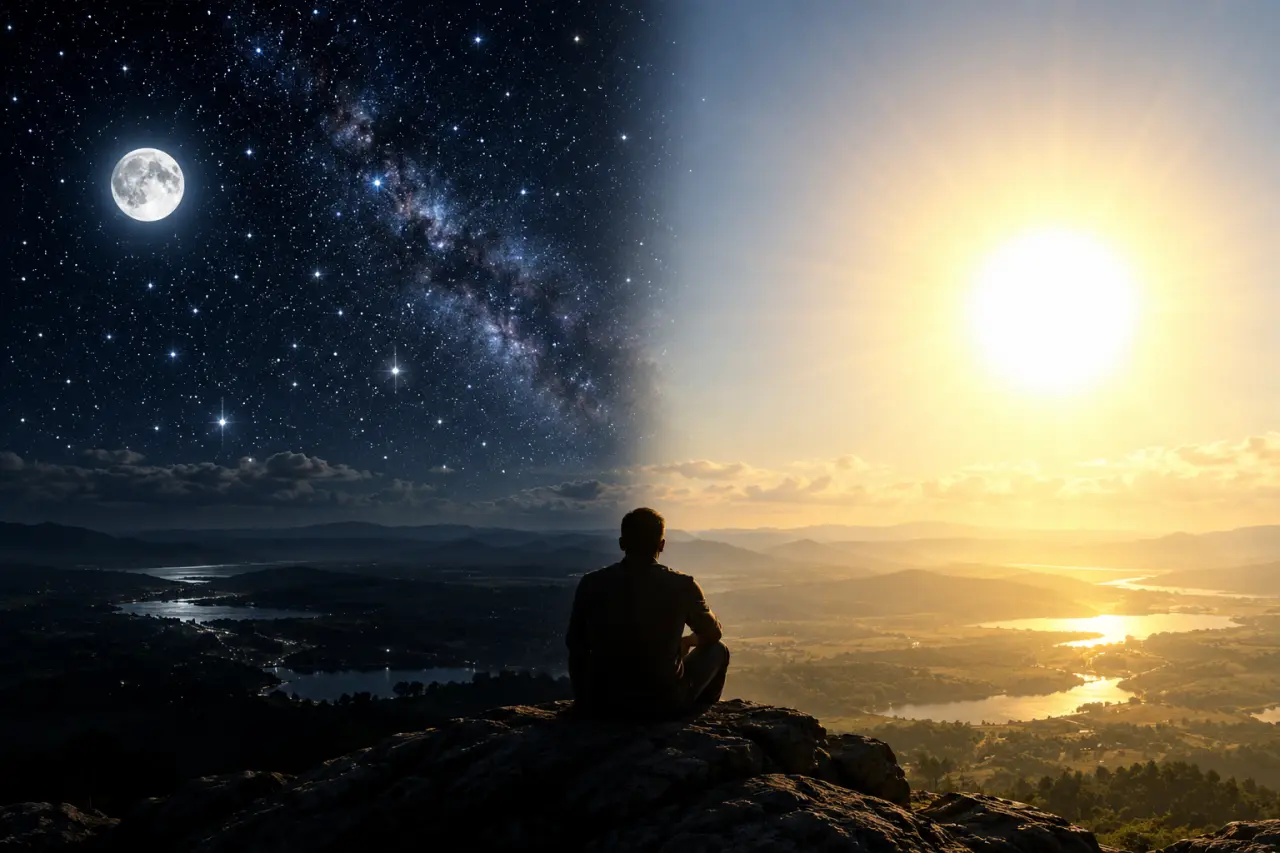 AI-generated (ChatGPT)Illustration © Genesis Logic
After time was defined, the sequence of experiences became definable, and the sequence of experiences made it possible for repeated experiences to appear, on the basis of which the intellect would become capable of recognizing the appearance of laws in experiences.
The recognition and description of laws is, in practice, the creation of a definition. We create definitions according to the best of our knowledge, that is, according to our experiences so far. The definitions then change and take shape through further experiences, because our later experiences make our initially imprecise definitions increasingly precise. And experiences repeat for as long as necessary.
Apparently, there are two major groups of our definitions created through experiences, of the laws we have come to know, but in reality there is only a qualitative difference. We come to know the laws through our experiences, because everything that appears in the material world is the appearance of laws.
Because of the process of knowing, what we come to know appears to be two groups, because during the process we first come to know an experience for which we do not yet have any meaningful explanation, we cannot define it, but we already recognize that it is a repeating experience, and therefore we recognize that it is the appearance of a law, but we are not yet able to define it in any way.
We know what its effect is, how it appears, and what actions it motivates us to take. We give an emotional response that we do not understand, and therefore the law that has begun to appear in our experiences will be identified as an emotion. We are able to interpret it as an emotion because we do not yet have enough experiences to create a meaningful definition.
As experiences repeat, we come to know the appearing law increasingly well, and the experience appears in connection with an increasing number of previously known laws, and therefore we also come to know increasingly well what network of relationships appears in connection with other laws.
We become capable of defining what we experience, and we create a definition, a law that, according to us, appears in our experiences. Further experiences then confirm or refute our definition, and therefore we change it so that it describes what we experience as precisely as possible.
As our definition changes, we see the past differently, where the definition was previously present within us in a different form, and we also see the future differently, which likewise changes as the definition changes.
The present is the only place where it is not our definition that appears, but reality, which does not adapt to our definition, but specifically points to its errors.
The emotions we have articulated and the definitions we have created also define us, because consciousness identifies with what it comes to know. The definitions consciously created represent true knowledge, which consciousness possesses, whereas the definitions that appear as emotions cannot be concretely defined by us; we can only identify them as emotions, but we experience their effects, and they are present in our lives as a compelling force.
The conscious I thus represents true knowledge with which we identify, and we interpret the will, the intention to change, that appears as the result of our knowledge as our own will, because we have identified with the knowledge that creates the will.
The unconscious I, on the other hand, is our I identified with the emotions, with whose will we cannot identify, because we cannot interpret it, we cannot understand how the will comes into existence; therefore, we perceive the will of the unconscious I as a compelling inner force. This too is I-identical, because the emotions appear within us in our own experiences, and therefore they are completely I-identical, so the will that appears through them is also completely I-identical. The reason we are not capable of identifying with it on the same level as with the will of the conscious I is that there are no definitions in the unconscious I on the basis of which we could formulate what causes the will that appears.
The firmament of Heaven is the present moment, in which reality appears; therefore, it is not only the laws created by God that appear in reality, but also what consciousness has understood from them.
If our definitions and our interpretation of emotions do not correspond to the laws in Heaven, then what appears through the Human also appears in the form in which we currently interpret the reality that appears.
The conscious I and the unconscious I also appear on the firmament of Heaven, that is, in the present, reality appears according to the laws created by God, and through us it appears in the form in which we are currently interpreting it.
Our conscious I and unconscious I thus appear in the present, and they appear clearly distinguished from one another. The conscious I, as the “Greater Light,” rules by “Day.” Day was defined in the previous text as the Conscious I, and Night was also defined as the Unconscious I. The “Lesser Light,” on the other hand, rules by “Night.”
There is not yet any possibility here of defining the word “rules,” because there is nothing to connect it to, there is not yet any defined knowledge to which we could connect it in order to interpret it, but in Genesis 1:26, where it appears again, we will already be able to define it; therefore, for now we can merely note that the word “rules” already appears here in connection with our Is.
The “Stars” also appear, as if mentioned only incidentally, but in the text of the Bible nothing is incidental, especially not a new name, which means the appearance of a new definition.
Based on the above, the stars appear in the night sky, but they are also present during the day; they are simply not visible during the day because then the light of our conscious I suppresses the visibility of the stars. This is not only so according to metaphor, but this is also what happens in reality.
At night, that is, when we respond unconsciously to an experience, we give an emotional response according to our unconscious I, and our will appears on an emotional level as a compelling force. It is not our conscious will that is realized, but we respond to the experience according to our emotions, and our own actions also appear on an emotional level; they are I-identical, but they are not identical with our conscious will.
In such cases, we do not know the why, the cause, of the emotional reactions that appear, yet our actions and reactions appear as completely self-identical. Since we do not know the definitions that appear in the events that appear, we also do not know the network of relationships that appears among the laws that appear, but the appearing experiences nevertheless point to other laws as well, which we do not yet know, but the consistency manifested in the experiences points out that here too we are witnessing law-governed events.
The experiences that are not known but are recognized as law-governed functioning point to laws that we likewise do not yet know; therefore, this experience becomes like the night sky. Our own reactions, as the “Lesser Light,” appear as I-identical in the experiences, while the appearing network of relationships indicates the presence of laws that we do not yet know, that we cannot define, and whose presence is shown only by the consistent repetition of the experiences in which they appear.
We therefore cannot distinguish the laws that appear, but they shine as stars in the experiences, and we already recognize their existence.
The stars are therefore the laws of Heaven, which first appear in a recognizable form in connection with our unconscious I, and on an emotional level we perceive that law-governed experiences are taking place in our lives.
When our conscious I is present, that is, when we give a conscious response to an experience, we describe the experience; we are able to define it. The stars are present even then, but because consciousness creates definitions to interpret the appearing experiences, we do not see the stars, but our own definitions, which thus conceal the true laws.
The conscious I defines everything that it perceives and experiences.
Our definitions are not necessarily identical with the true laws that appear in our experiences, but we continuously shape and form our definitions so that they become increasingly precise. This is why time and the repetition of experiences are essential, because every repetition is a new opportunity to make our created definitions more precise. Thus, the definitions of the conscious I describe the appearing reality with increasing precision.
“14 And God said, Let there be lights in the firmament of Heaven to divide the day from the night; and let them be for signs, and for the defining of seasons, and days, and years.
15 And let them be for lights in the firmament of Heaven to give light upon the earth. And it was so.
16 And God made two great lights; the greater light to rule the day, and the lesser light to rule the night; and the stars.”
Since the conscious I was given the name Day, the Greater Light does not mean the conscious I, but the creation of the conscious I, that is, the creation of definitions, which is carried out by the Intellect.
According to our previous interpretations, the Intellect is not a property of the Human, but a fundamental definition that exists independently of consciousness, which the text already defined in verse 3 as light.
Here, from the perspective of consciousness, it is clearly defined that the Intellect creates definitions from the information perceived by consciousness, with which consciousness identifies, and therefore the Greater Light creates definitions for consciousness, and consciousness consists of these definitions.
Specifically, the information perceived by consciousness is presented to the Intellect, from which the Intellect creates definitions, and these definitions become unified explanations with which consciousness identifies. The conscious I is created by the Intellect.
Greater Light: Intellect.
The Greater Light differs from light in that light means the Intellect present in the world, which means the consistency and network of relationships between the laws that define the world, whereas the Greater Light is the part of the Intellect that is specifically available to consciousness. Light means the complete network of relationships that exists among the laws of Heaven, while the Greater Light, as Intellect, is capable of interpreting the laws and the network of relationships existing among them on the basis of the amount of information perceived by consciousness.
The difference is therefore quantitative: consciousness is capable of accessing the Intellect according to the amount of information mediated by the body; therefore, it is given a separate name here, but light, as Intellect, is limited neither in the amount of information nor in time nor in space. Light is a timeless and unlimited law that already existed before the definition of time. Time and the repeated experiences made possible by time make the Greater Light limited; the Intellect designated by the Greater Light interprets only the information that consciousness has already perceived. Thus the process of knowing is built up, which is already bound to time, while the Intellect as light remains timeless and unlimited.
In the case of the Lesser Light, the situation is the same, with the difference that from the experiences perceived by consciousness, that is, from the available information, it is not yet possible to create a unified and meaningful explanation, a definition. Therefore, from this information, definitions do not arise; only responses that can be defined on the basis of a repeating pattern appear as emotional responses.
We have no definition, no explanation for why things happen, but the response to the recognized repeating experience is always the same, so the response to the experienced event is already known. Without an explanation or definition, these responses return to consciousness as an emotional response, and thus they enter our unconscious I as emotions.
Lesser Light: Emotion.
The laws known by consciousness are therefore not the true laws that determine the appearance of the material world, but those that it has understood from them on the basis of its experiences so far. It perceives the world in its experiences, but interprets it according to its interpretations defined so far. If what happens is not what it expects according to the definitions it has created so far, then it further refines and specifies its definitions so that they describe its experiences as precisely as possible.
The conscious I is therefore not capable of seeing or perceiving the laws created by God; rather, it perceives the material world through the body's sensory organs, and on the basis of its experiences it becomes increasingly capable of defining the laws that appear in the reality it experiences.
The unconscious I, however, does not create definitions; it only knows the reactions given to the appearing experiences, which appear in reality according to God's laws. The network of relationships that appears in this way is likewise not capable of revealing the true laws that determine the world; therefore, they shine in the present as stars, as points of light, which the unconscious I is not capable of interpreting or defining, but it is aware of their presence because they concretely determine the emotions and emotional reactions. The stars are therefore indicators of the concrete laws that are not known but actually determine the world, and which have already appeared in our experiences.
Stars: Concrete laws.
“16. And God made two great lights; the greater light to rule the day, and the lesser light to rule the night; and the stars.
17. And God set them in the firmament of Heaven to give light upon the earth;
18. And to rule the day and the night, and to divide the light from the darkness. And God saw that it was good.”
Through these definitions, God makes it understandable to consciousness how it comes to know the world through its experiences. After the definition of time, experiences already appear to consciousness as a sequence of experiences. The experiences repeat, and thus it becomes recognizable that the material world operates according to laws. The recognition is at first only the recognition of law-governed functioning and the recognition of law-governed reactions; therefore, it appears on an emotional level, through the recognition of emotions and emotional responses.
The further repetition of experiences makes the experiences increasingly interpretable; the information continuously arriving through the body is returned to consciousness by the Intellect in the form of definitions, in the form of meaningful explanations, which it further specifies during its subsequent experiences.
Verse 14 says:
“14 And God said, Let there be lights in the firmament of Heaven, to divide the day from the night; and let them be for signs, and for the defining of seasons, and days, and years.”
After the definition of time, the sequence of experiences makes it possible to come to know the laws one by one, which thus creates notable points in time. The days and years point to the repetition of experiences, and thus the feast days appear in the text, which are points in time that signify the recognition of a law.
Feast: Understanding.
The understanding of the laws of God is a feast; therefore, on each such occasion, we come closer to God.
The recognition of a law is always a Feast, because the purpose of life is actually knowing, knowing and understanding the laws of the world, which is made possible by repeating experiences.
These definitions therefore follow the previous ones completely logically. After the appearance of time and repeating experiences, the Intellect and emotion that appear in time can be specifically defined from the perspective of consciousness, which became necessary because of time, since previously the Intellect was present only as timeless and unlimited, that is, in a form that could not be interpreted by consciousness in time. The Intellect and emotion thus appear to consciousness in the sequence of experiences in a defined manner, and the laws of Heaven also appear in the sequence of experiences in the appropriate order, according to their knowability.
Fourth Day: The definitions of intellect, emotion, and the elements of knowledge.
The fourth cycle of creation.
The definition of intellect and emotion, which, through experiences, lead to knowledge, to the knowledge and understanding of concrete laws (stars).